
Insurance fraud is not a rounding error. The Coalition Against Insurance Fraud estimates that fraud costs the United States roughly $308.6 billion per year, and the Insurance Information Institute reports that an estimated 10–20% of property & casualty claims involve some element of fraud. A meaningful share of that exposure traces back to one weakness: when the first notice of loss is just a description, the claim file starts out thin, late and easy to manipulate.
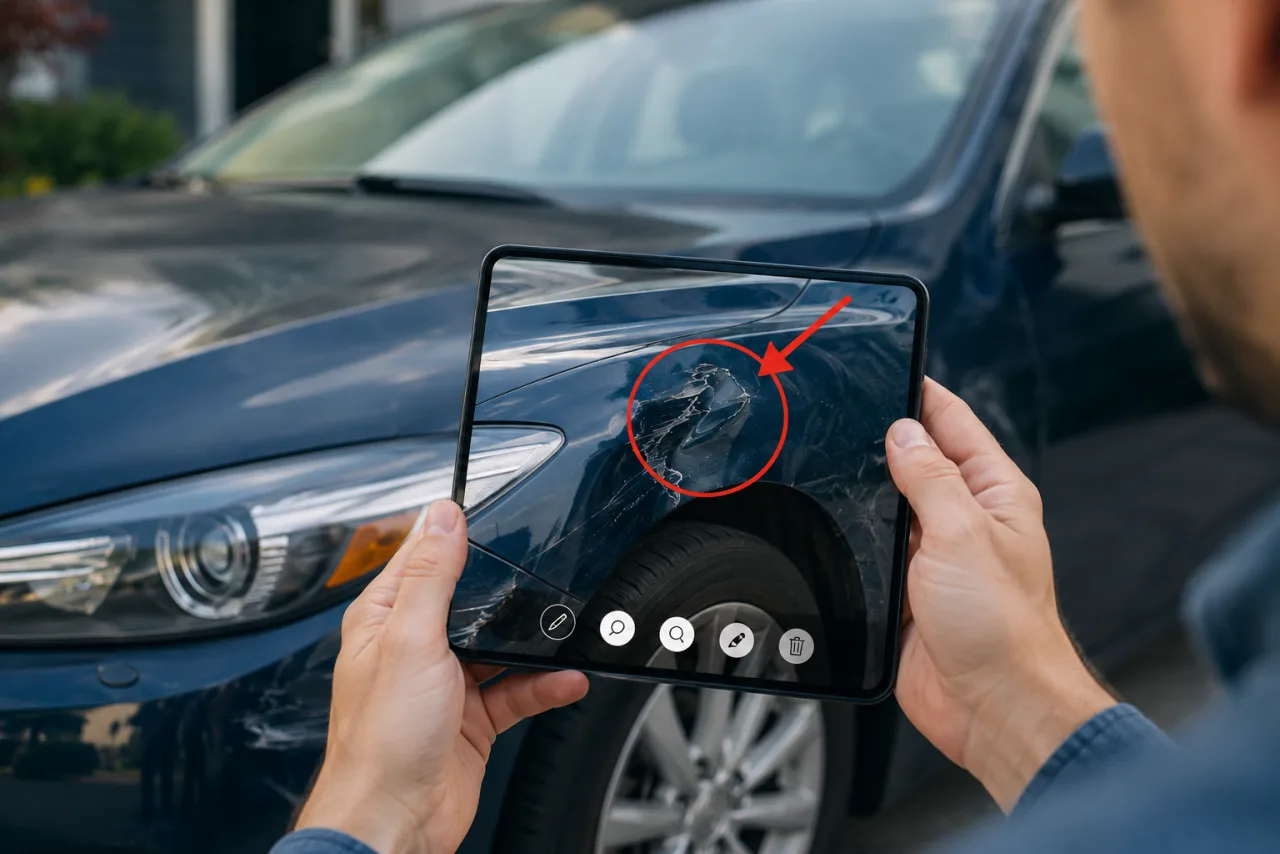
Capturing visual evidence at FNOL flips that. When the loss is recorded live — through the policyholder’s phone camera, with time stamps and geolocation — the insurer holds verifiable proof of what the damage was, where it was, and when it was reported, from minute one. That doesn’t just help investigators after the fact; it deters opportunistic fraud before it starts.
Why phone-only FNOL is a fraud risk
Traditional FNOL relies on after-the-fact reconstruction: the policyholder describes the loss, perhaps emails photos later, and an adjuster pieces it together. That gap creates room for the common patterns of opportunistic claims fraud — pre-existing damage presented as new, staged or exaggerated losses, inflated severity, and photos that can’t be tied to a time or place. The weaker and later the first-notice evidence, the more of this slips through.
How visual evidence at FNOL deters fraud
Live capture removes the reconstruction gap
A remote visual inspection at first notice means the adjuster sees the actual loss as it’s reported, not a curated set of images submitted later. There’s no opportunity to substitute or stage between the event and the evidence.
Time stamps and geolocation anchor the claim
Photos and recordings captured in-session carry metadata — when and where they were taken — so the loss can be tied to the reported time and location. Inconsistencies surface immediately instead of months into an investigation.
AR-guided capture closes blind spots
The adjuster directs the view in real time — “show me the VIN,” “pan to the other side,” “get the odometer” — so the file is complete and a claimant can’t simply avoid showing inconvenient details.
A defensible audit trail
The full session is recorded and attached to the claim, creating documentation that supports special-investigation-unit (SIU) review and stands up if the claim is disputed later.
Deterrence, not just detection
The most valuable effect is preventive. When policyholders know the first step is a live, recorded visual session rather than a quick phone description, opportunistic exaggeration becomes far less attractive. Honest claimants are unaffected — for them, video FNOL simply means a faster, easier claim — while the friction lands precisely on the behavior insurers want to discourage.
Balancing fraud defense with customer experience
Fraud controls often add friction that annoys honest customers. Visual FNOL is unusual in that it improves the experience for legitimate claimants while tightening evidence against bad actors. That matters because the claims experience drives loyalty: in J.D. Power’s 2025 study, 52% of claimants with a poor digital experience were at risk of leaving, versus 4% with an excellent one. A visual FNOL that feels fast and modern protects retention and the claim file at the same time.
Privacy and compliance
Capturing visual evidence means handling personal data, so the platform matters. Look for explicit policyholder consent to share the camera, end-to-end encrypted sessions, and compliance with GDPR and HIPAA plus relevant data-residency requirements — so stronger fraud defense never comes at the cost of a compliance gap.
The fraud patterns visual FNOL helps address
Most opportunistic claims fraud exploits the gap between when a loss happens and when the insurer sees it. Capturing evidence live at first notice closes that gap against several common patterns:
- Pre-existing damage presented as new. Live capture with time and location metadata makes it far harder to pass off old damage as part of a fresh claim.
- Exaggerated severity. When the adjuster directs the view and sees the full extent in real time, inflated descriptions don’t survive contact with the camera.
- Staged or phantom losses. Geotagged, time-stamped video ties the loss to a specific place and moment, exposing inconsistencies with the reported circumstances.
- Selective documentation. AR-guided capture lets the adjuster request the exact angles — VIN, odometer, the other side of the vehicle — so a claimant can’t simply omit inconvenient details.
None of these require accusing anyone. The session simply produces a complete, anchored record, and the inconsistencies that used to surface months into an investigation surface in the first few minutes.
What adjusters watch for in a visual session
A live session also gives trained handlers real-time signals to note (and route to an SIU when warranted): reluctance to show specific areas, damage inconsistent with the described event, metadata that doesn’t match the reported time or location, or attempts to keep the camera off the most relevant detail. Capturing these observations in the recorded session strengthens the file either way — confirming a legitimate claim quickly or flagging one that needs a closer look.
Frequently asked questions
How much does insurance fraud cost? The Coalition Against Insurance Fraud estimates U.S. insurance fraud at about $308.6 billion per year, and the Insurance Information Institute estimates that 10–20% of P&C claims involve some fraud.
How does visual evidence at FNOL reduce fraud? It captures the loss live, with time-stamped and geotagged photos and a recorded session, at the first notice — removing the reconstruction gap, anchoring the claim to a time and place, and creating a defensible audit trail that both deters opportunistic fraud and supports investigations.
Does it create privacy concerns? Handled correctly, no. The policyholder explicitly consents to sharing their camera, sessions are end-to-end encrypted, and a compliant platform meets GDPR/HIPAA and data-residency requirements.
Key takeaways
- Insurance fraud is large (~$308.6B/year in the U.S.; 10–20% of P&C claims) and often exploits weak, late first-notice evidence (Coalition Against Insurance Fraud; III).
- Live, time-stamped, geotagged capture at FNOL removes the reconstruction gap, anchors the claim, and builds a defensible audit trail.
- The biggest win is deterrence — and unlike most fraud controls, it improves the experience for honest claimants.
- Use a consent-based, encrypted, GDPR/HIPAA-compliant platform so fraud defense doesn’t create a compliance risk.
See the full workflow on our visual claims & video FNOL page, or read about video FNOL and reducing claims cycle time and LAE.
Request a demo to see verifiable visual evidence capture in action.