
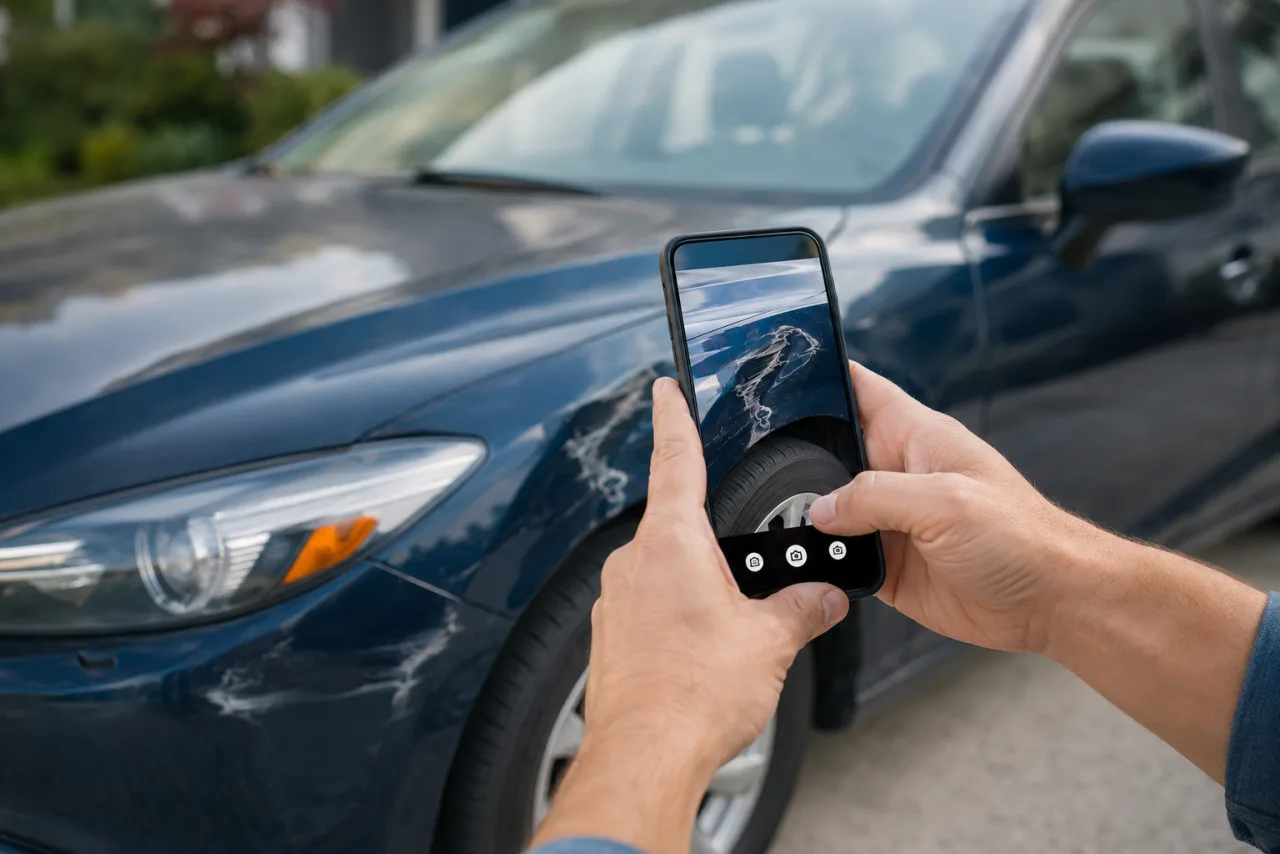
The First Notice of Loss (FNOL) is the moment a claim begins — and the moment that quietly determines how fast, how cheaply and how well it will be resolved. Traditionally, FNOL is a phone call or a form: the policyholder describes what happened, and the insurer makes decisions based on words. Video FNOL changes that by adding a live, app-free video layer to first contact, so the insurer can see the loss the instant it’s reported.
Instead of guessing at severity from a description, a claims handler watches the policyholder’s smartphone camera in real time, guides the view with on-screen AR annotations, and captures time-stamped, geotagged photos as verifiable evidence — all at first notice. The result is faster triage, fewer unnecessary site visits, stronger fraud defense and a claims experience customers actually rate well.
What is video FNOL?
Video FNOL is the practice of capturing a loss on live (or guided, app-free) video at the first notice of loss. The policyholder taps a link, opens their phone camera in the browser — no app to download — and shows the damage; the adjuster sees it live, annotates the frame, and documents it. It’s a form of remote visual inspection applied to the very start of the claims process. (For a short definition, see our glossary: what is video FNOL?)
Why the first notice sets the trajectory of the whole claim
Everything downstream — triage, routing, reserving, whether an adjuster is dispatched, how long settlement takes — flows from the quality of information captured at FNOL. When that information is a verbal description, the insurer is forced to hedge: assume the worst, dispatch someone to look, and wait. When it’s live video plus annotated photos, the insurer can act with confidence from minute one.
This matters because the claims experience is now a primary driver of retention. In J.D. Power’s 2025 U.S. Claims Digital Experience Study, 52% of auto and home claimants who rated their digital claims experience “poor” or “just OK” said they were likely to switch or not renew — versus just 4% of those who rated it “excellent.” A slow, opaque FNOL is exactly the kind of experience that pushes customers out the door.
How video FNOL speeds up claims
Instant, accurate triage
Seeing the loss lets the handler gauge severity immediately and route the claim correctly — fast-tracking simple losses for near-instant decisions and escalating complex ones with the right information attached.
Fewer in-person inspections
Many claims don’t actually need a field adjuster; they need someone to see the damage. The auto industry’s shift makes the point: according to LexisNexis Risk Solutions, insurers went from handling under 15% of claims virtually to roughly 60% — a durable move away from in-person inspection. Video FNOL is what makes that shift possible at first contact.
Lower loss adjustment expense
Avoiding unnecessary visits and shortening cycle time directly reduces cost. McKinsey research links end-to-end claims digitization — of which remote/virtual handling is a core lever — to a 25–30% reduction in loss adjustment expense (LAE). (More on this in our post on reducing claims cycle time and LAE.)
A documented, defensible file
Because the evidence is captured live — time-stamped and geotagged — the claim file is stronger from the start, which speeds settlement and supports fraud review.
Why “no app” is non-negotiable for FNOL
FNOL happens at a stressful moment, often roadside or in a damaged home. Asking a policyholder to download an app, create an account and grant permissions is enough friction to kill the session — and push the claim back to phone-and-dispatch. Browser-based video FNOL removes that step: the adjuster sends a link, the policyholder taps it, allows the camera, and the session starts. A tool 20% of claimants can use changes a metric; a tool nearly any claimant can use changes the operating model.
What a video FNOL session looks like
- The loss is reported. The policyholder calls or files online; the handler opens a visual session.
- A link goes out. By SMS or email — no app, no account.
- The damage is captured live. The policyholder points their camera; the adjuster sees it in real time.
- The adjuster guides and documents. AR annotations mark the damage; geotagged photos attach to the claim.
- The claim is triaged or resolved. Simple losses are fast-tracked; complex ones escalate with full visual context.
Where video FNOL fits
Video FNOL is strongest for visually assessable losses — auto damage, property damage, contents and appliances — and for the new-customer claims where a fast, confident first experience most affects retention. It complements, rather than replaces, complex investigations that still need specialist field work.
Video FNOL vs traditional FNOL
The difference is best seen side by side. Take a routine auto claim — a parking-lot dent.
Traditional FNOL: The policyholder calls and describes the damage. The handler can’t gauge severity confidently from words, so they open a claim with a wide reserve and schedule a field adjuster “to be safe.” The customer waits three days for the visit, then more days for the assessment. Photos arrive by email, but one angle is missing, so there’s a follow-up. The claim is open for a week or more, costs include a dispatch, and the customer’s first real experience of their insurer is a delay.
Video FNOL: The handler texts a link during the first call. The policyholder opens their camera, and within ninety seconds the handler sees the dent, annotates it, and captures geotagged photos. The severity is obvious, the claim is fast-tracked, no adjuster is dispatched, and the customer is told what happens next before they hang up. The file is complete and documented from minute one.
Same loss, very different cost, cycle time and customer impression. The traditional path defaults to dispatch and wait; the video path defaults to see and decide.
Rolling out video FNOL
Adopting video FNOL is an operational change more than a technical one. The highest-impact rollout pattern:
- Pick the right claim types first. Visually assessable losses — auto damage, property and contents, appliances — are where video FNOL pays off immediately.
- Script the hand-off. A short, reassuring prompt — “I’ll send you a link so we can look at this together; there’s nothing to install” — drives adoption.
- Set the triage rule. Define when a visual session should precede any dispatch decision, so adjusters aren’t booked before the loss is seen.
- Measure the pair. Track cycle time and in-person inspection rate with reopen rate and CSAT, so speed and accuracy improve together.
Frequently asked questions
What does FNOL stand for? FNOL stands for First Notice of Loss — the first report a policyholder makes to an insurer when a loss or damage occurs. Video FNOL adds a live video layer to that first report.
Does video FNOL require the policyholder to install an app? No. With a browser-based tool, the adjuster sends a secure link, the policyholder taps it and allows camera access, and the session runs in the phone’s browser — no app store, no account.
Does video FNOL replace field adjusters? No. It removes unnecessary visits and makes the necessary ones more efficient by attaching accurate visual evidence to the claim before anyone is dispatched.
Key takeaways
- FNOL quality determines a claim’s whole trajectory; video FNOL captures live, verifiable information at first contact.
- It speeds triage, cuts in-person inspections (the auto industry went from <15% to ~60% virtual — LexisNexis) and lowers LAE (25–30% from claims digitization — McKinsey).
- The claims experience drives retention: 52% vs 4% switch risk by experience quality (J.D. Power 2025).
- “No app” browser access is what makes FNOL adoption high enough to matter.
See how it comes together on our visual claims & video FNOL page, or read about reducing claims cycle time and reducing fraud with visual evidence.
Request a demo to see video FNOL in action.