
For telecom and ISP operators, the truck roll is one of the most expensive line items in customer support. Every time a technician is dispatched to a subscriber’s home, the operator absorbs the cost of the vehicle, the fuel, the technician’s time, and the scheduling overhead — and the customer absorbs a multi-day wait. Industry estimates put the fully loaded cost of a single dispatch at a few hundred dollars, and a large share of those visits turn out to be avoidable.
The problem is visibility. When a subscriber calls about “no internet” or “slow Wi‑Fi,” a voice-only agent is working blind. They cannot see the blinking lights on the modem, which cable is in which port, or whether the splitter in the hallway has come loose. Faced with uncertainty, the safest call is often to dispatch a technician — even when the real fix is a 30-second cable swap the customer could have done themselves.
What a truck roll actually costs
It is easy to underestimate a dispatch because the obvious number — the technician’s hourly rate — is only part of it. A single truck roll bundles together:
- Vehicle and fuel: the fleet cost per visit, including maintenance and depreciation.
- Technician labor: not just on-site time, but travel time between appointments.
- Scheduling and dispatch overhead: the back-office cost of booking, routing, and rescheduling no-shows.
- Opportunity cost: every avoidable visit consumes a slot that a genuinely necessary repair now has to wait for, stretching appointment windows for everyone.
- Customer-experience cost: the multi-day wait itself erodes satisfaction and raises the odds the subscriber churns.
Add these up and the difference between “resolved on the call” and “dispatched a van” is rarely a few dollars — it is hundreds, multiplied across thousands of monthly contacts.
Most dispatches are avoidable — here’s the pattern
When operators review their dispatch logs, a striking share of visits resolve in minutes once a technician arrives, because the root cause was never a hardware fault. The most common avoidable categories are:
- Cabling errors: a cable in the wrong port, a loose connector, or a coax/ethernet mix-up.
- Power and reboot issues: a modem that never finished booting, or a device on a switched outlet.
- Configuration and account state: a service that needs re-provisioning, or Wi‑Fi credentials entered incorrectly.
- Placement problems: a router buried in a cabinet or too far from where coverage is needed.
- Customer education: the equipment is fine; the subscriber just needs to be shown how to use it.
Every one of these is something an agent could resolve in real time — if they could see it.
Seeing the problem changes the decision
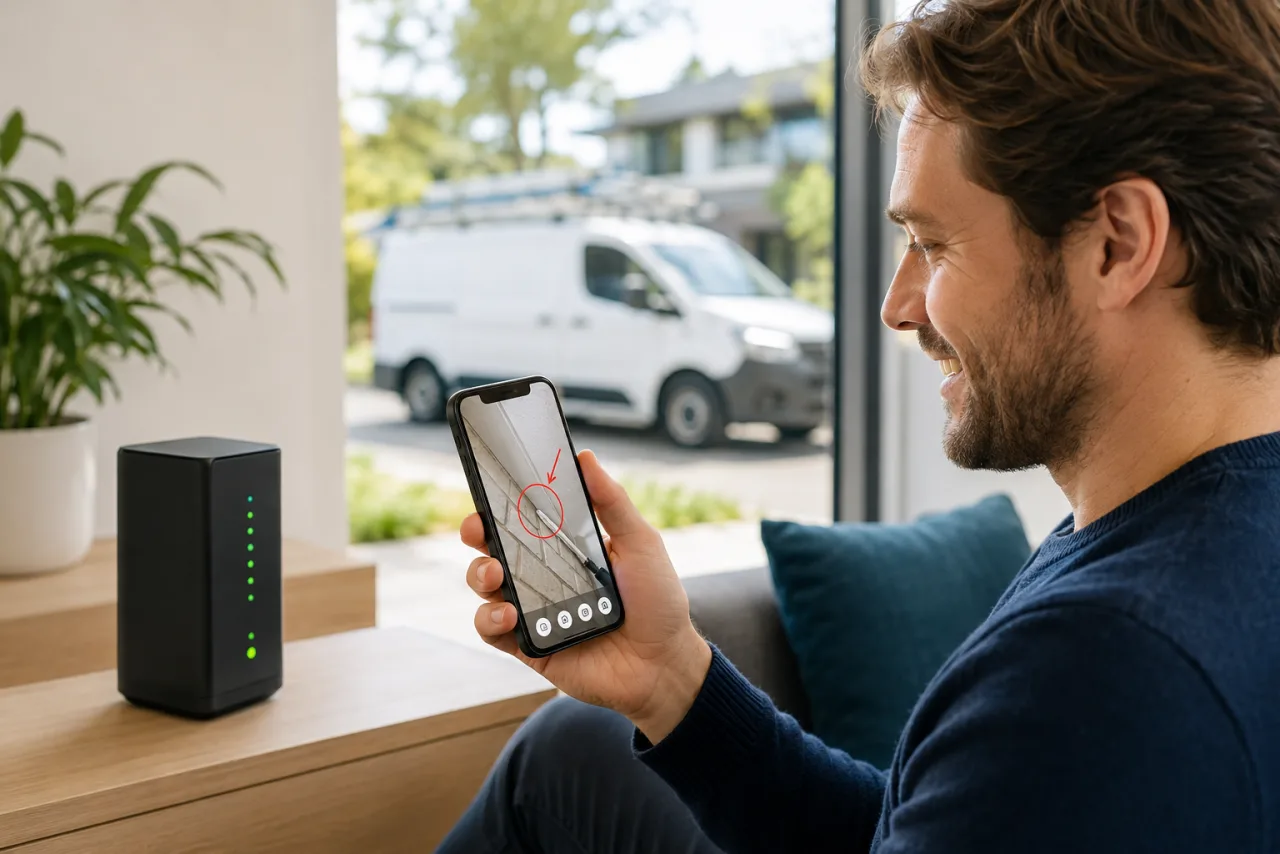
Telecom visual support closes the visibility gap. Mid-call, the agent sends the subscriber a secure link by SMS. The customer taps it, the camera opens directly in their phone’s browser — no app to download — and the agent instantly sees what the customer sees.
With a live view of the router and the home setup, the agent can:
- Confirm whether the fault is something the customer can fix on the spot (a loose cable, a wrong port, a power issue).
- Walk the customer through the fix with on-screen AR annotations, pointing to the exact port or button.
- Verify the real fault before booking a dispatch — so when a technician is needed, they arrive with an accurate diagnosis instead of a guess.
That last point matters even for the visits that still happen: a dispatch created from a visual session carries documented fault information and photos, so the field team arrives ready to solve the right problem the first time, instead of spending the first twenty minutes re-diagnosing it on the doorstep.
The measurable impact
The effect on dispatch volume is significant. A Tier‑1 telecom operator that integrated VSight Remote into its contact center saw field visits drop by 30%, while first-contact resolution climbed to as high as 80%. Agents launch a visual session only when it is actually needed, and most are resolved in 5–7 minutes — faster than the voice-only back-and-forth they replace.
Across more than 10,000 visual sessions per month and 4,400+ post-session ratings, customer satisfaction averaged 7.8 out of 10, with subscribers citing fast resolution and easy, no-download access as the highest-impact factors.
Crucially, the savings compound. Every avoided dispatch frees a field slot, which shortens appointment windows for the repairs that genuinely need a technician. Reducing avoidable truck rolls doesn’t just cut cost — it increases the capacity of the field organization without adding headcount.
Why “no app” is the unlock
Many remote-support tools fail in consumer support for one simple reason: asking a frustrated customer to download an app, create an account, and grant permissions is enough friction to kill the session. Browser-based visual support removes that step entirely. The customer only has to tap a link — which is exactly why adoption is high enough to move dispatch numbers at scale. A tool that 20% of customers can use changes a metric; a tool that 90% of customers can use changes the operating model.
How to spot an avoidable dispatch in the first 60 seconds
Agents don’t need to be engineers to triage a call for visual support. A simple checklist catches most avoidable dispatches before a van is ever booked:
- Is the issue physical and visible? Cabling, lights, device placement, screen messages — anything the camera can show is a candidate for remote resolution.
- Has the customer already rebooted with no change? If a script-based reboot failed, the next step should be seeing the setup, not dispatching blind.
- Is the customer at home with the equipment in reach? If they can point a phone at the modem, the agent can almost always diagnose it.
- Is this a repeat contact? Repeat callers are both the highest churn risk and the highest-value candidates for a definitive visual fix.
If the answer to the first three is “yes,” a visual session should come before any dispatch decision — not after the customer has already been promised a technician.
Measuring the impact
To know whether visual support is actually reducing truck rolls, track a small set of paired metrics rather than dispatch count alone:
- Dispatch rate on eligible call types (activation, no-service, Wi‑Fi) before vs after.
- Avoidable-dispatch rate — the share of completed visits that resolved in minutes with no parts replaced (your best proxy for “shouldn’t have been a truck roll”).
- Repeat-contact rate within 7 days, to confirm remote fixes are sticking.
- Cost per resolved contact, which captures both the dispatch savings and any added session time.
Watching these together prevents the classic mistake of celebrating fewer dispatches while quietly pushing the problem into callbacks.
Frequently asked questions
How much does a single truck roll cost a telecom operator? Estimates vary by market, but the fully loaded cost — vehicle, fuel, technician time, travel, and scheduling overhead — is commonly cited at $150 or more per visit, before counting the customer-experience cost of the wait.
What share of telecom truck rolls are actually avoidable? A large share. When operators audit completed visits, many resolve in minutes with no hardware replaced — cabling, power, configuration, placement, or customer-education issues a visual session could have fixed remotely.
Does visual support replace field technicians? No. It removes the avoidable visits and makes the necessary ones more efficient, because dispatches created from a visual session carry an accurate, documented diagnosis.
Key takeaways
- Avoidable truck rolls are expensive because the cost is bundled (vehicle, labor, scheduling, lost capacity, churn) — not just the technician’s time.
- The root cause of avoidable dispatches is visibility: voice-only agents dispatch when uncertain.
- Browser-based visual support lets agents verify and often fix the fault remotely; a Tier‑1 operator cut field visits by 30%.
- Triage eligible calls to a visual session before booking a dispatch, and measure dispatch rate alongside repeat-contact rate.
Getting started
Reducing truck rolls does not require ripping out your existing stack. Visual support layers on top of the agent’s current console and integrates with leading CRM and CCaaS platforms, so sessions launch from where agents already work and outcomes are written back to the customer record. The change is operational, not architectural: train agents on when to escalate a call to a visual session, and the dispatch curve starts bending within the first reporting cycle.
To see how it works on your own calls, explore visual support for telecom call centers or learn how the same approach cuts average handle time and improves first-call resolution.
Request a demo to see VSight Remote in action.