
Average handle time (AHT) is one of the most closely watched metrics in any telecom contact center — and one of the hardest to improve without hurting quality. Push agents to talk faster and first-contact resolution suffers; let calls run long and cost per contact climbs. The real lever is not talking faster; it is removing the guesswork that makes technical-support calls run long in the first place.
Where the minutes go
On a voice-only support call, a huge share of the time is spent translating between what the customer sees and what the agent imagines. “Is the light blinking or solid?” “Which cable — the yellow one or the white one?” “What does the screen say exactly?” Each round trip adds time, and misunderstandings send the call down the wrong path entirely. For technical issues like router setup or Wi‑Fi troubleshooting, this back-and-forth is the single biggest driver of long calls.
A voice-only call vs a visual call
Consider a typical “no internet” call handled two ways.
Voice only: The agent asks the customer to describe the modem lights. The customer isn’t sure which light is which. The agent walks through a generic reboot script. It doesn’t help. The agent asks about cabling; the customer reads the labels, but one is ambiguous. After several minutes the agent still isn’t confident in the diagnosis, so — to be safe — they book a technician. Total: a long call and a truck roll, with the problem still unsolved.
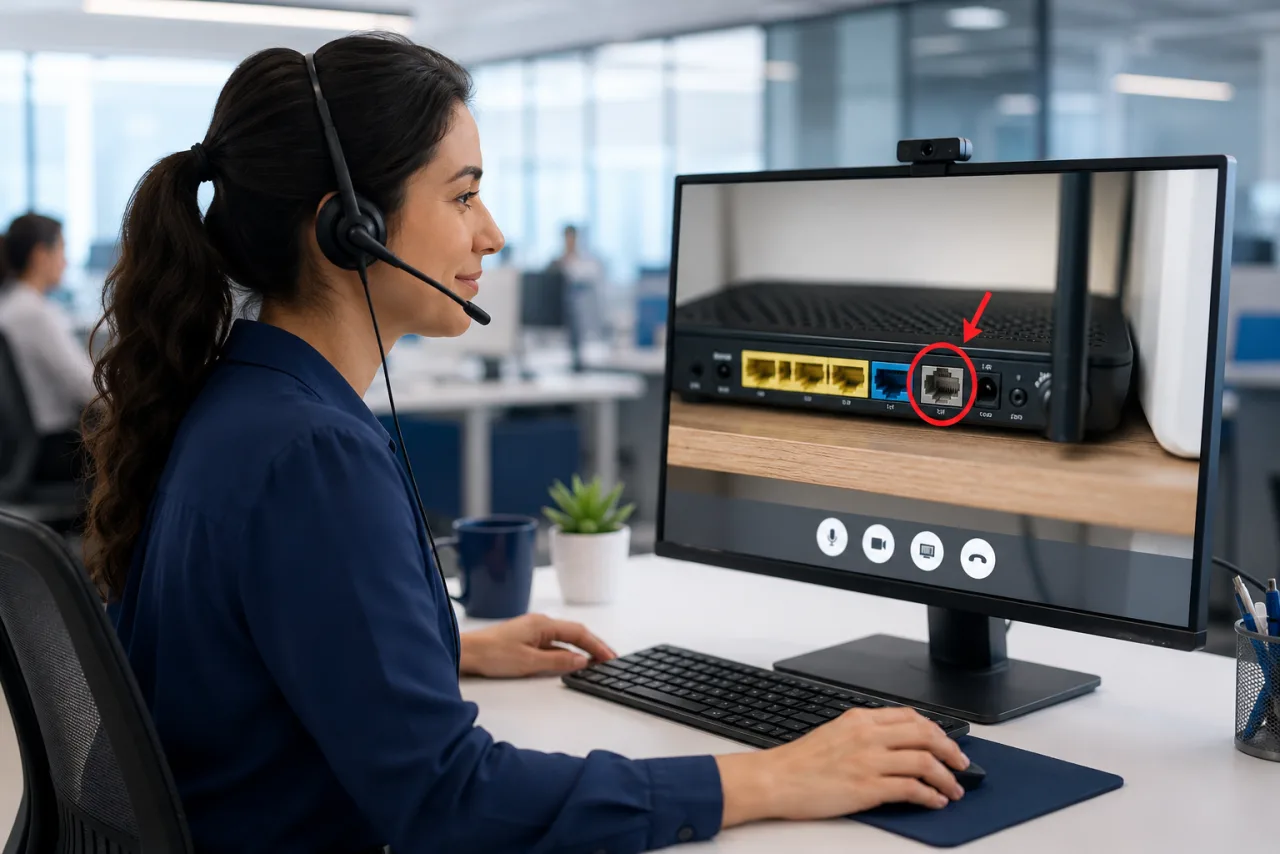
With visual support: The agent sends a link, the customer opens the camera, and within seconds the agent sees a coax cable seated in the wrong port. They draw an arrow on the live image, the customer moves the cable, the lights go green, and the call ends. Total: a few minutes, resolved, no dispatch.
Same issue, radically different handle time — because one agent was guessing and the other was looking.
Replacing description with a live view
Telecom visual support collapses that back-and-forth into a single shared view. The agent sends a link, the customer opens their phone camera in the browser — no app required — and the agent sees the modem, the cabling and the error lights directly.
From there, the agent can:
- Diagnose the actual fault in seconds instead of inferring it from a verbal description.
- Use AR annotations to point to the exact port or button, eliminating “no, the other one” loops.
- Freeze a frame to explain a step clearly, then confirm the customer did it correctly — live.
The result is a call that follows the shortest path to resolution instead of wandering through guesses.
The callback tax
Raw AHT can be misleading, because it only counts the call in front of you. The hidden cost of voice-only troubleshooting is the callback tax: a call that ends “fast” but unresolved generates a second contact tomorrow, and sometimes a third. Two seven-minute calls that fail to fix the problem are far more expensive than one ten-minute call that solves it — in agent time, in customer frustration, and in the escalations and dispatches that follow.
This is why AHT should never be optimized in isolation. Visual support improves AHT in the right way: not by rushing agents, but by making them accurate enough that the first call is the last call. Fewer callbacks means lower true cost-to-serve even when an individual visual session takes a minute longer than a rushed voice call.
The numbers
At a Tier‑1 telecom operator running VSight Remote across 200+ contact-center agents, most visual sessions are resolved in 5–7 minutes, and first-contact resolution reached as high as 80%. Crucially, agents launch a visual session only when it adds value — so the tool sharpens handle time on exactly the calls that would otherwise drag, without adding overhead to simple ones.
Faster, accurate resolution compounds: fewer repeat calls, fewer escalations, and 30% fewer field dispatches, all of which pull total cost-to-serve down while customer satisfaction (measured at 7.8 / 10 across 4,400+ ratings) goes up.
Rolling it out without hurting simple-call AHT
A common worry is that adding a step — sending a link, waiting for the camera — will increase handle time. The key is selective use. The best programs train agents to escalate to a visual session only when the issue is visual and voice has stalled; a billing question or a password reset never needs it. Used this way, visual support has no effect on the simple calls and a large effect on the complex ones, which is exactly where AHT pain concentrates.
A simple rollout playbook:
- Define triggers — the call types where agents should offer a visual session (activation, no-service, Wi‑Fi, device setup).
- Script the hand-off — a one-line, reassuring prompt that explains there’s nothing to install.
- Measure the right pair — track AHT and first-contact resolution together, so the team optimizes for resolved time, not just short time.
Quality and AHT, together
The reason visual support improves AHT without the usual quality trade-off is simple: it makes agents more accurate, not just faster. Seeing the problem prevents the misdiagnoses that create callbacks, and callbacks are AHT’s hidden tax. A call resolved correctly in seven minutes beats two “fast” calls that each end without a fix.
Measuring it the right way
To prove visual support is improving handle time without gaming the metric, watch these together:
- AHT on eligible call types (technical/connectivity), not the whole queue — that’s where visual support applies.
- First-contact resolution in parallel, so you never trade a short call for an unresolved one.
- Repeat-contact rate within 7 days, the truest test of whether the “fast” call actually fixed the problem.
- Visual-session adoption rate on eligible calls, to confirm agents are escalating when they should.
A healthy rollout shows AHT on technical calls dropping while FCR rises and repeat contacts fall. If AHT drops but callbacks climb, you’re rushing, not resolving.
A note on agent experience
There is a human dimension that rarely shows up on dashboards: voice-only technical troubleshooting is stressful. Agents spend the call uncertain, bracing for the customer’s frustration, and often end it without confidence the problem is solved. Seeing the issue removes that ambiguity — agents resolve with certainty, hear fewer angry callbacks, and burn out less. Lower handle time and lower agent attrition tend to move together.
Turning sessions into long-term AHT reduction
The biggest AHT gains from visual support compound after the call. Because sessions are recorded, they become a structured library of how real problems actually look and get solved — and that library pays off two ways.
First, coaching. Instead of role-playing hypothetical calls, supervisors review real visual sessions to show new agents exactly how a top performer diagnoses a fault in seconds. Ramp time shrinks, and the whole team converges on the fastest resolution path — which pulls average handle time down structurally, not just on the calls that use video.
Second, upstream fixes. When the same confusion shows up across dozens of sessions — say, customers repeatedly plugging the fiber cable into the wrong port — that’s a signal. The operator can fix the root cause once (a clearer install guide, a colored port label, a better unboxing flow) and remove a whole category of calls from the queue. Visual support doesn’t just shorten calls; it tells you which calls shouldn’t be happening at all.
Frequently asked questions
What is a good average handle time for a telecom contact center? It varies widely by call type, so a single target is misleading. The more useful goal is reducing AHT on complex technical calls without lowering first-contact resolution — which is exactly where visual support helps.
Does adding a visual session increase handle time? Only if used on the wrong calls. Applied selectively to technical and connectivity issues — where voice-only back-and-forth is the bottleneck — it shortens the call. Simple calls (billing, password) skip it entirely.
How quickly do most visual sessions resolve? At a Tier‑1 telecom operator, most are resolved in 5–7 minutes, because the agent diagnoses the fault by seeing it rather than inferring it.
Key takeaways
- AHT runs long on technical calls mainly because of verbal back-and-forth and misdiagnosis.
- Visual support collapses that into a shared live view, cutting time and preventing the callbacks that inflate true cost.
- Use it selectively on technical calls; measure AHT alongside FCR and repeat-contact rate.
- Most visual sessions resolve in 5–7 minutes, and accurate first calls reduce the “callback tax.”
Where to go next
If AHT and cost-per-contact are on your scorecard, visual support is one of the few levers that improves them while raising resolution quality. Explore visual support for telecom call centers, or see how the same approach reduces truck rolls and lifts first-call resolution and CSAT.
Request a demo to see it on your own calls.