
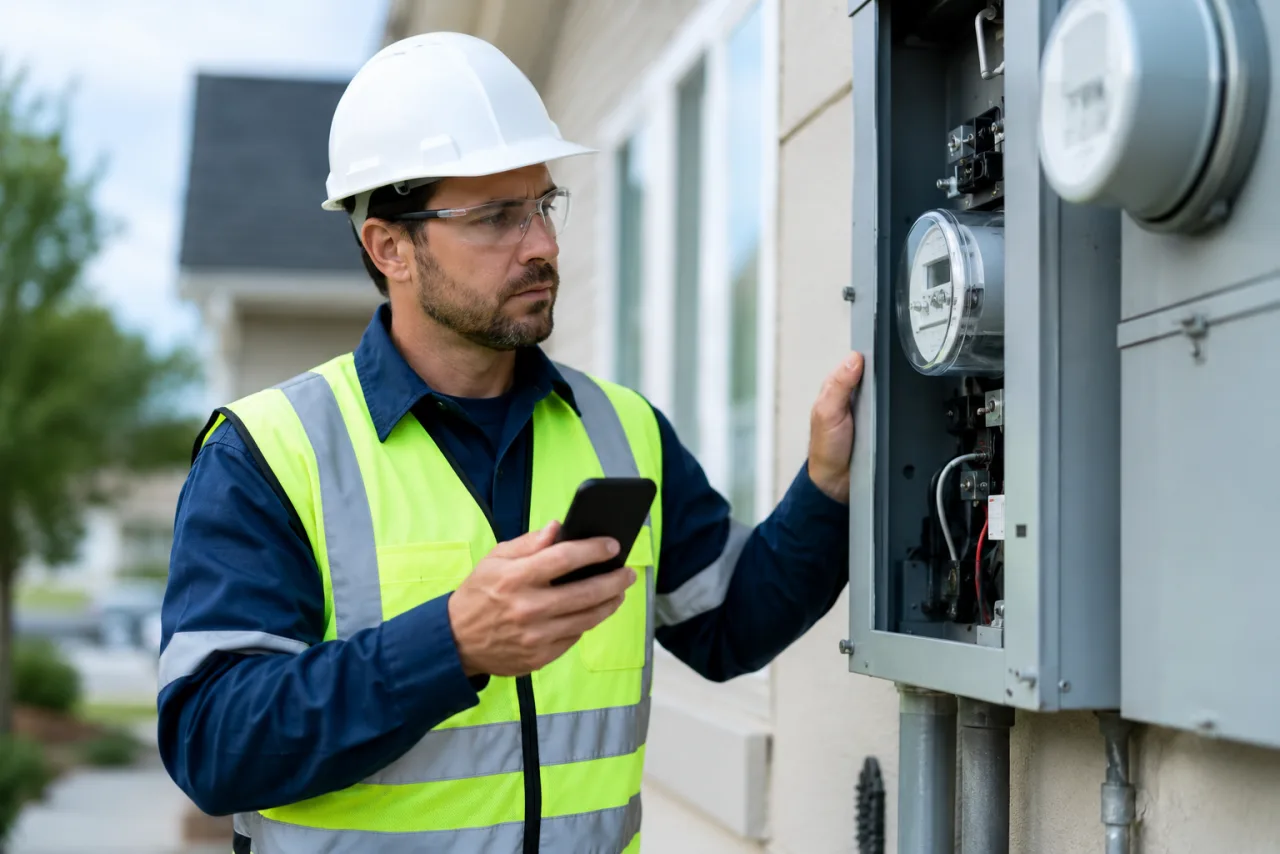
Field dispatches — “truck rolls” — are among the most expensive operations a utility runs, and a large share of them are avoidable. Utilities commonly estimate a single dispatch at $250–$500 as a conservative figure (S&C Electric), and a widely repeated cross-industry estimate puts the all-in cost closer to $1,000 once labor, vehicle, scheduling overhead and lost capacity are counted. Multiply that across thousands of monthly visits — many for issues that were never physical faults — and truck rolls become one of the clearest cost-reduction opportunities on the table.
The root cause is familiar: when the utility can’t see the customer’s meter, connection or device, dispatching a crew feels safer than diagnosing blind.
The avoidable-dispatch problem — and the digital gap behind it
A meaningful portion of utility field visits resolve quickly with nothing replaced: a meter that needs re-seating, a connection issue, a customer who needs to be shown how to read or use a device. These are exactly the issues a remote expert could handle — if they could see them.
The opportunity is amplified by how far behind utility customer experience sits. J.D. Power’s 2024 study put utility digital-experience satisfaction at just 594/1,000 — far below wealth-management (718) and insurance (702) apps — with 27% of utilities offering no mobile app at all. Customers want to self-serve and get help digitally; most utilities can’t yet meet them there. Visual support closes both gaps at once: it deflects avoidable dispatches and delivers the modern, digital support experience customers increasingly expect.
How remote visual support cuts truck rolls
Visual support gives the utility eyes on the problem before committing a crew:
- See it live. The customer points their phone camera at the meter, panel or device; the agent sees it in real time — no app to download.
- Resolve remotely. Many issues are fixed on the call with AR-guided steps, removing the dispatch entirely. (See what a truck roll costs.)
- Triage the rest. When a visit is genuinely needed, the agent confirms the fault and books the right crew with the right parts.
- Arrive prepared. The dispatch carries a documented, photo-backed diagnosis, raising first-time fix and avoiding repeat trips.
Beyond customers: field-to-expert truck-roll avoidance
Truck rolls aren’t only customer-facing. A field crew that hits an unfamiliar problem often triggers a second visit by a specialist. With visual support — by phone or hands-free smart glasses — a remote expert sees the crew’s point of view and guides them through the job, turning two trips into one. This also helps with the workforce crunch: with up to ~50% of the utility workforce expected to retire within 5–10 years (CEWD), expert-on-demand keeps scarce senior knowledge available everywhere at once.
Measuring the impact
- Dispatch rate on eligible issue types (meter, connection, device, billing-related), before vs after.
- Avoidable-dispatch rate — completed visits that resolved in minutes with nothing replaced.
- First-time fix rate on the dispatches that do happen.
- Digital-channel adoption / CSAT — to confirm you’re also closing the experience gap.
Which utility visits are most avoidable
Not every dispatch can be replaced, but a recognizable set of high-volume visits often can be triaged or resolved remotely:
- Meter issues — re-seating, reading confusion, “my meter looks wrong,” smart-meter setup and pairing.
- No-power / no-service complaints that turn out to be a tripped breaker, a customer-side fault, or a neighborhood issue already known to the utility.
- New connections and move-ins where the customer needs guidance, not a technician.
- Device and in-home energy equipment — thermostats, EV chargers, solar/storage interfaces the customer can’t configure.
A visual session lets the utility confirm, in the first contact, whether any of these actually need a crew — and resolve the ones that don’t.
A connection issue, two ways
A customer calls: “I have no power to half my house.” The old way: the agent can’t see anything, so a crew is dispatched; they arrive to find a tripped sub-panel breaker the customer could have reset — a wasted truck roll and a half-day wait. With visual support: the agent has the customer show the panel on camera, identifies the tripped breaker, and guides them to reset it safely — resolved in minutes, no dispatch, and the agent escalates only if the panel shows a genuine fault.
Beyond cost: the customer-experience dividend
Truck-roll reduction is usually framed as cost savings, but in utilities it doubles as a customer-experience fix — and that matters more than it used to. With utility digital-experience satisfaction sitting at just 594/1,000 (J.D. Power), customers increasingly judge their provider by how modern and responsive support feels, not only by the power bill. A multi-day wait for a technician to look at something the customer could have shown on video is exactly the kind of friction that drags those scores down.
A visual session flips that experience: the customer gets help in minutes, on the channel they already prefer, with no app to install. The same action that removes an avoidable dispatch also delivers the digital, self-service-style interaction customers want — so cost-to-serve and satisfaction improve together rather than trading off. For regulated utilities where satisfaction scores feed into rate cases and regulatory standing, that dividend can matter as much as the direct savings.
A simple rollout
Utilities don’t need a platform overhaul to start. The fastest path:
- Pick the highest-volume avoidable call types (meter, no-service, device setup) for a first pilot.
- Add a visual-session step before any dispatch decision on those call types.
- Equip field crews with smart glasses for the field-to-expert escalations that turn two trips into one.
- Track dispatch rate, first-time fix and CSAT together so cost and experience gains are both visible.
Frequently asked questions
How much does a utility truck roll cost? Utilities commonly estimate a field dispatch at $250–$500 each as a conservative figure (S&C Electric). A widely repeated cross-industry estimate puts the all-in cost near $1,000 once labor, vehicle, scheduling and lost capacity are included, though no primary benchmark study for that figure is publicly available.
How does remote visual support reduce truck rolls in utilities? An agent sees the customer’s meter, connection or device live and resolves it remotely, or triages whether a visit is needed. Dispatched crews arrive with an accurate, documented diagnosis.
Does this require the customer to install an app? No. Customer sessions run in the mobile browser — the utility sends a secure link, the customer taps it and allows camera access, and the session starts.
Key takeaways
- Utility dispatches cost ~$250–$500 (S&C Electric), and are commonly estimated at ~$1,000 all-in across field service; many are avoidable.
- Utility digital experience lags badly (594/1,000; 27% have no app — J.D. Power), so visual support cuts dispatches and closes the experience gap.
- Remote visual support resolves issues live, triages the rest, and sends prepared crews — plus field-to-expert guidance turns two trips into one.
- Expert-on-demand also offsets the ~50% workforce retirement wave (CEWD).
See our utilities & energy visual support page, or read about the aging utility workforce and remote inspection for safety.
Request a demo to see it on your operation.